
Hydrogen-Powered MX-5: Could a Fuel-Cell Miata Happen?
Miatas have no rear seat and tiny trunks, so traveling with a dog means planning around the passenger seat, knowing how the airbag behaves, managing wind in a soft top, and packing light. NA/NB are ~5 ft³, NC a bit bigger, and ND soft-top/RF are the tightest of all.


A fuel-cell Miata is technically doable, but the packaging fight is real. To make it work, you’d cram in a compact PEM stack (roughly 60–130 kW), at least one 700-bar Type-IV hydrogen tank, a small traction battery, an e-motor or e-axle, serious cooling, and all the high-voltage and hydrogen safety hardware. Even the “small” commercial modules and car-sized tanks add a few hundred kilos and swallow most of a Miata’s rear storage. With hydrogen stations still clustered in a handful of regions, this is more “killer engineering exercise or demo build” than a practical street product, at least right now.
What a Fuel-Cell Miata Really Could Mean
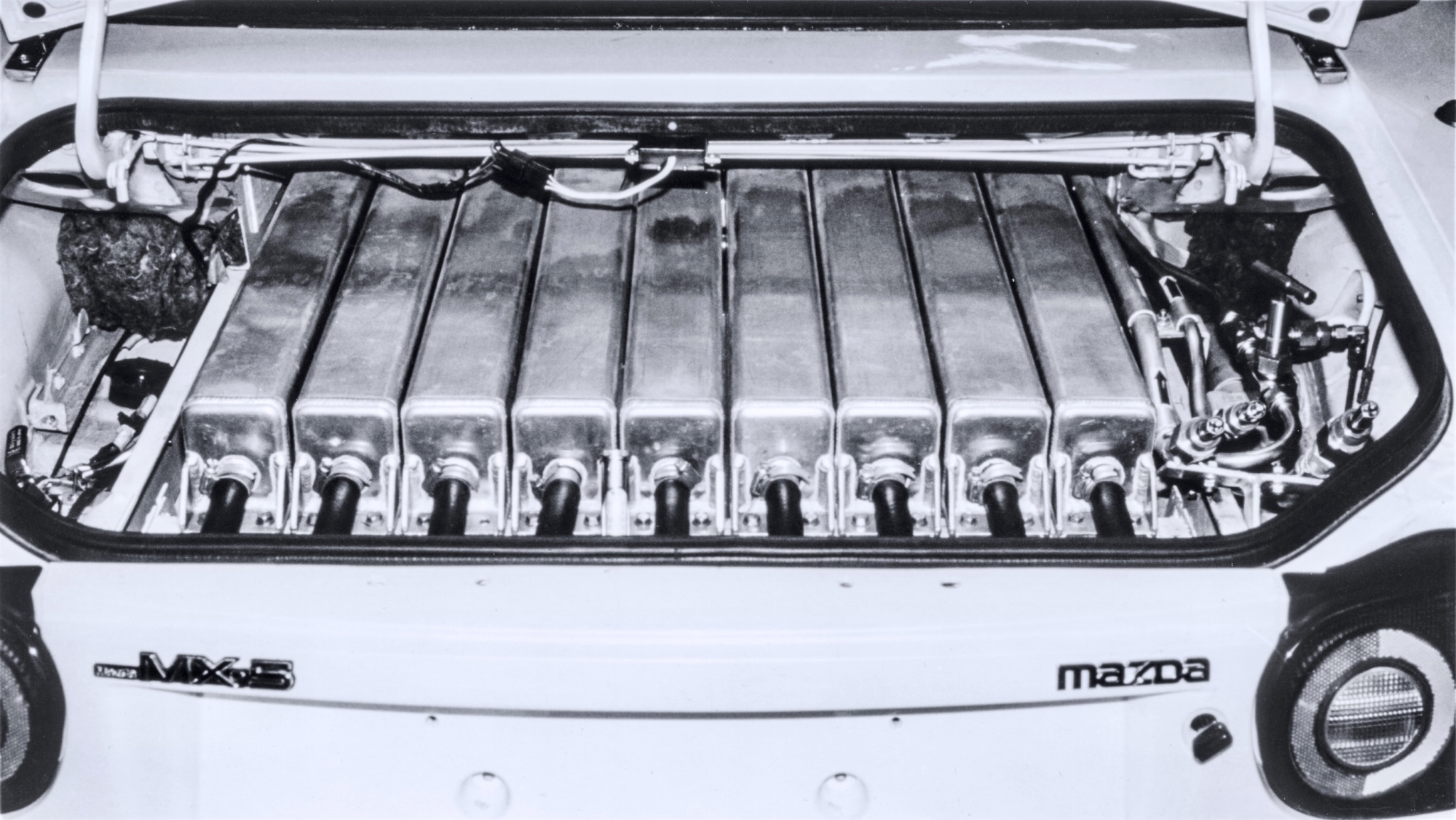
The prime mover is a PEM fuel-cell stack that turns hydrogen into electricity. As a mental model, think of modern passenger-car stacks in the ~60–130 kW range: the bare stack might be around the size and mass of a small engine, but once you include the balance-of-plant (air compressor, humidifier, coolant pumps, DC/DC), the packaged module becomes fridge-sized and a couple hundred kilograms. You still add a lithium-ion buffer battery, light compared with full EV packs, to smooth transients and capture regen. For propulsion, a single permanent-magnet synchronous motor around 100–150 kW keeps the car feeling “Miata-right” on power.
Why Even Pick Hydrogen?
Refueling time is minutes, tailpipe emissions are just water, and the car can keep that light-battery, eager throttle feel instead of carrying a huge EV pack. The trade is upstream: well-to-wheel emissions depend on how the hydrogen is produced, and today’s passenger-car refueling network is thin. Big automakers still invest in fuel cells (especially for heavier vehicles), but the passenger-car case remains split, with some manufacturers pausing or pivoting while others push ahead.
Will It Fit?
Fitting everything into a tiny roadster is the whole game. You need space for the stack module, large radiators and chillers, an air compressor and humidifier with plumbing, at least one 700-bar tank, the buffer battery, and a motor/inverter, inside a two-seat convertible with a small trunk and short crush zones. The vertical fuel-cell module is typically too tall for a stock bay without major bonnet and subframe work, so a remote mount behind the seats or against the bulkhead is more realistic, with new crash structure to suit. A usable 700-bar tank that stores more than a couple kilograms of hydrogen is bulky; in practice, you’re building an armored cylinder bay that consumes most of the trunk and fuel-tank tunnel. Cooling is not optional: even efficient stacks dump plenty of heat at cruise power, so you’re talking bigger front heat exchangers and careful underbody ducting. Add the masses, module, tank(s), battery, e-axle, and it’s easy to push an ND from roughly 1,100 kg into the 1,350–1,500+ kg zone unless you aggressively downsize and lighten elsewhere.
How Much Hydrogen for Miata-Like Range?
Use a modern fuel-cell sedan as a scaling reference. Those cars carry around five to six kilograms of hydrogen spread over multiple tanks to reach several hundred kilometers of range. A two-seat roadster likely fits a single 700-bar tank in the two-to-three-kilogram ballpark, which pencils out to roughly 150–250 km of mixed driving. That’s workable for a demo or local use, not a grand-tour roadster.
Safety and Compliance You Can’t Ignore
Automotive hydrogen systems live under strict global standards. Certified 700-bar tanks are tested for pressure cycling, bonfire, and ballistic threats, and must be mounted in protected structures with temperature-activated pressure relief devices. You also need hydrogen leak detection and well-designed vent paths that route gas away from occupants. On the high-voltage side, interlock loops and fail-safe shutdowns are standard practice. A convertible’s short rear overhang and minimal trunk structure make the tank bay the hardest single packaging problem.
Controls and Thermal Strategy That Drive Well
Fuel-cell cars are hybrids by design: the stack loafs near its sweet-spot efficiency while the battery covers short power bursts. For a Miata you’d aim the stack around 60–80 kW continuous and let the battery supply peak power to roughly 120–140 kW at the motor. Thermal management needs separate loops for the stack, power electronics, and cabin, plus big frontal area for radiators. If you don’t design for continuous 40–60 kW on a hot day, the car will heat-soak and derate.
Plausible Performance Targets
Peak power around 120–140 kW can put 0–100 km/h in the high-six to low-seven-second range, right in the neighborhood of a warmed-up Miata. Keep added mass to roughly 300 kg by using one small tank, a single 60–80 kW module, and a compact e-axle, and accept the shorter range. Overbuild the cooling pack if you want repeatable performance.
Precedents and Lessons
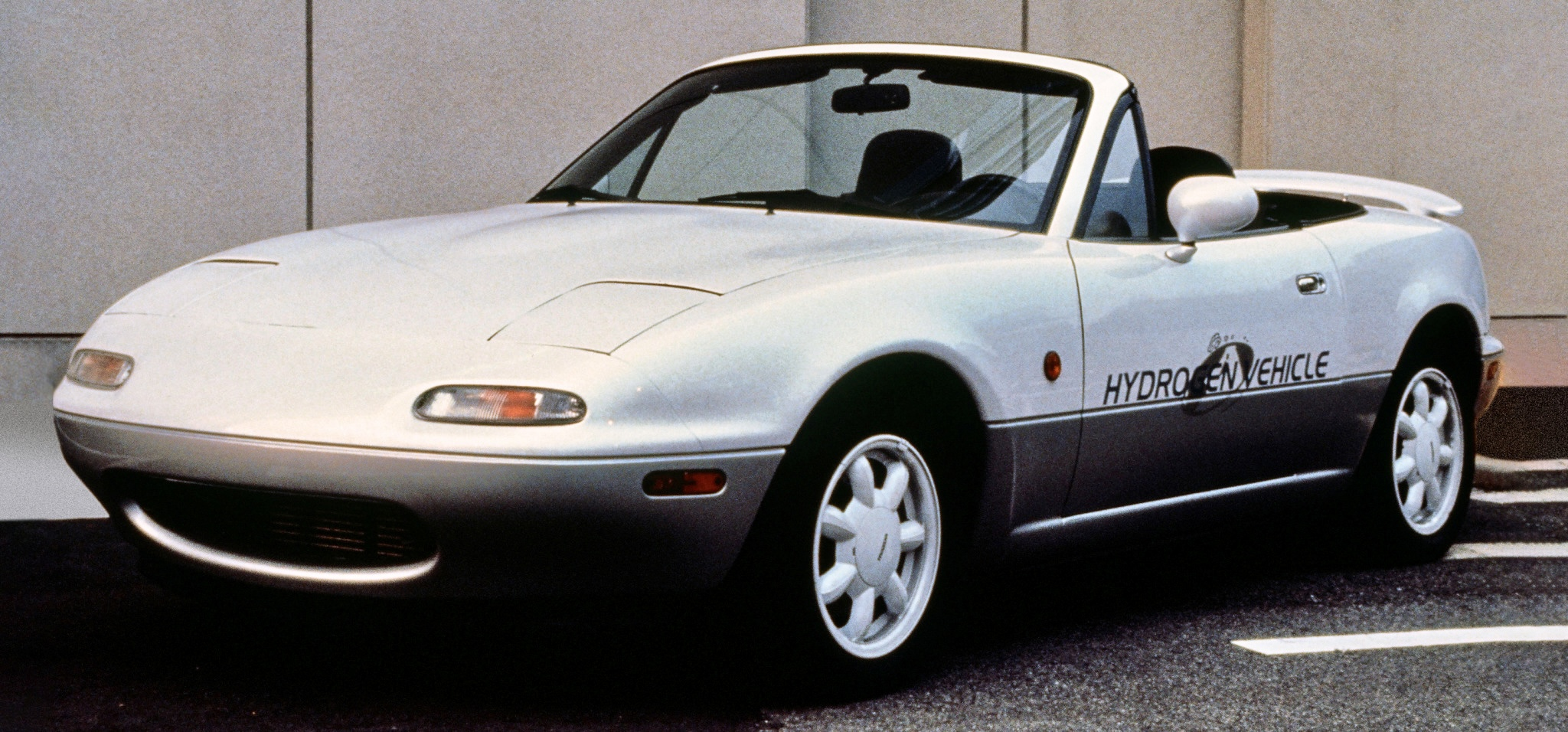
There’s relevant history to learn from even if it isn’t fuel-cell-specific. Mazda’s hydrogen projects with the RX-8 and the now then Premacy used hydrogen internal-combustion rotaries, not stacks, and showed how quickly range collapses when you’re limited by packaging and pressure. On the other side, large-platform demonstrations, hydrogen SUVs and trucks, highlight how much easier this becomes when you have the volume for multiple tanks and bigger radiators. The Miata simply doesn’t give you that space for free.
Reality of Going Hydrogen
Hydrogen stations number in the low thousands worldwide but are concentrated in a few countries and regions. The United States has only a small number of public light-duty stations, mostly in California, and some have closed or paused service. If you don’t live near pumps, you’re looking at trailering or arranging hydrogen delivery. Pricing also varies wildly and can be policy-sensitive.
A Sensible Build Path If You’re Serious
A show-car or engineering mule could run a single 60–80 kW module, one 700-bar tank around two kilograms of hydrogen, a compact e-axle, and a big front radiator stack. Keep the soft-top but budget the trunk for a reinforced, externally vented tank bay. Target 150–200 km of mixed range and roughly 1,350–1,450 kg curb with aggressive lightweighting. For a track demonstrator, strip the interior, integrate the tank cradle into a safety cage, consider lower-pressure tanks to save mass with more frequent refuels, and size the stack for stout continuous output while the battery handles sprints.
A stock ND makes roughly mid-130s kilowatts at around 1,100–1,150 kg and can travel several hundred kilometers on petrol with a usable trunk. A single-tank fuel-cell ND targets about 120–140 kW peak, weighs roughly 1,350–1,500+ kg depending on choices, likely delivers 150–250 km per fill, and gives up most of the trunk to a certified tank bay. Refueling time is comparable, where stations exist.
If you want a daily-drivable, long-range, hydrogen-powered Miata today, the trade-offs are steep: heavier curb weight, trimmed range, and a trunk sacrificed to pressure vessels. As a proof-of-concept or a sustainability showpiece, though, it absolutely works and would make an epic build story. For near-term road use, a battery-electric conversion remains the simpler, better-supported path while hydrogen tech and infrastructure catch up.


